
This section places Speicher elektrisiert within a well-established innovation framework. The analysis explains why the model worked, where it reached structural limits, and why further development was not only reasonable but necessary.
Table of Contents
Desirable: Clear Demand, Tangible Impact
A product is desirable when it solves a real problem in a real market. In this dimension, Speicher elektrisiert was strongly positioned.
Users were looking for:
- orientation in a new technological field
- technical explanation of complex systems
- confidence in everyday use
- support in purchasing decisions
- reassurance that issues were not isolated cases
- realistic expectations instead of marketing promises
The project delivered this orientation. Demand was consistent and clearly visible.
The data shows a clear pattern:
- high interaction rates
- long-term relevance of evergreen content
- recurring demand for in-depth explanatory formats
- strong pull effects driven by YouTube search and Google search
The Desirable dimension was fully met.Desirable war vollständig erfüllt.
Feasible: Execution Was Possible, Capability Was Present
Feasible beschreibt, ob ein Modell umsetzbar ist. Auch hier gab es keine Feasible describes whether a model can be executed reliably. Here, too, there were no limiting factors.
Execution was enabled by:
- strong analytical capability
- structured, methodical thinking
- clear conceptual frameworks
- modern production tools
- direct access to real user feedback
- continuous observation of market and software development
Operationally, the model was sound:
- content could be produced independently
- issue analysis was possible
- real-world usage testing worked reliably
- community questions provided precise insights
Feasible was fully met.
Viable: The Four Dimensions of Sustainability
The decisive question is whether a model can be sustained long-term within its system. This is where limitations emerged. Not because of missing success, but because of structural conditions outside the project itself.
Viability consists of four interdependent dimensions:
Structural Integration
A sustainable model requires:
- defined interfaces
- clear points of contact
- processes for external analysis
- reliable information flows
- consistent access to vehicles and expertise
This infrastructure does not exist in traditional automotive environments.
The limitation was not a lack of willingness by individuals, but the architecture of large organizations that were not designed for independent analytical formats.
As a result, long-term structural integration was limited.
Monetization Logic
Value creation was clearly present.
Value capture was not.
Key facts:
- advertising does not sustain highly specialized explanatory content
- revenues are volatile and difficult to plan
- sponsorship opportunities are constrained by external perception
- community support is valuable but structurally limited
- OEM-side mechanisms to compensate independent analysis do not exist
- the created value could not be economically captured
The model worked in terms of impact, but not in terms of sustainable monetization.
Content Economics (Content Gap)
A format is only as stable as its thematic foundation.
Observed constraints:
- few models result in limited topic breadth
- long product cycles
- slow and irregular software updates
- gradual evolution of core functionalities
- declining number of genuinely new, relevant questions
- high analytical depth reduces topic repetition
The content gap was therefore structural, not qualitative.
Demand continued to grow, but the supply of new topics did not scale accordingly.
Scalability
A viable model must be able to scale, horizontally or vertically.
In the case of Speicher elektrisiert, the following factors were limiting:
- horizontal scaling across additional models was not possible
- vertical scaling through formal cooperation was not structurally supported
- diversification risked breaking contextual trust
- OEM dependency constrained all growth paths
The format was effective, but not scalable.
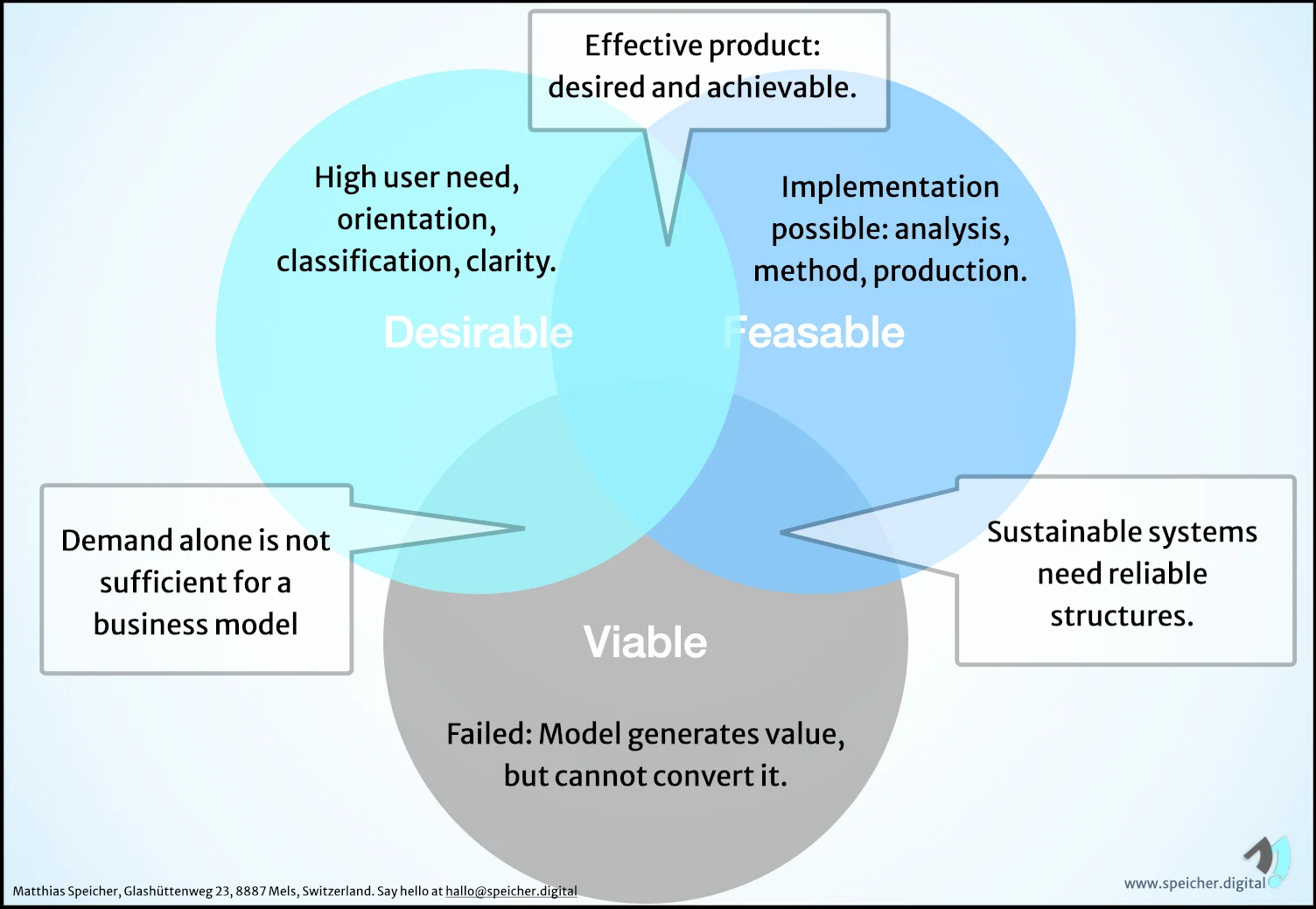
Overall Assessment: Why the Pivot Is Logical
The analysis reveals a consistent pattern:
- Desirable: fulfilled
- Feasible: fulfilled
- Viable: not fulfilled, for structural reasons
The model reached its maximum impact within its existing context.
Further development requires a different environment.
The pivot is therefore not a reaction to failure, but the logical outcome of a clear and honest analysis.
Speicher elektrisiert demonstrated how independent formats can decode complex systems and make user perspectives visible in technology-driven markets. The next phase follows the same logic, but in a context that supports long-term viability.