
This article describes how Speicher elektrisiert works today. It shows how the project functions as a knowledge system and how the individual components of the Business Model Canvas and Lean Canvas interlock.
Table of Contents
Starting point: A project becomes a systemic knowledge model
After Speicher elektrisiert was created, the project quickly developed beyond the character of a side project.
With increasing demand, a growing community and rising complexity, the need arose to map the model in a structured way.
Speicher elektrisiert is structured in response to a clearly defined market logic: users need technical guidance, OEM communication is not sufficient for this, and community knowledge can only be used if it is structured.
The project therefore does not work like a traditional media channel, but like an analytical system: it collects real data, checks it, structures it and makes it available for use – for users, dealers, OEM-related players and the media.
The Business Model Canvas as a structural basis
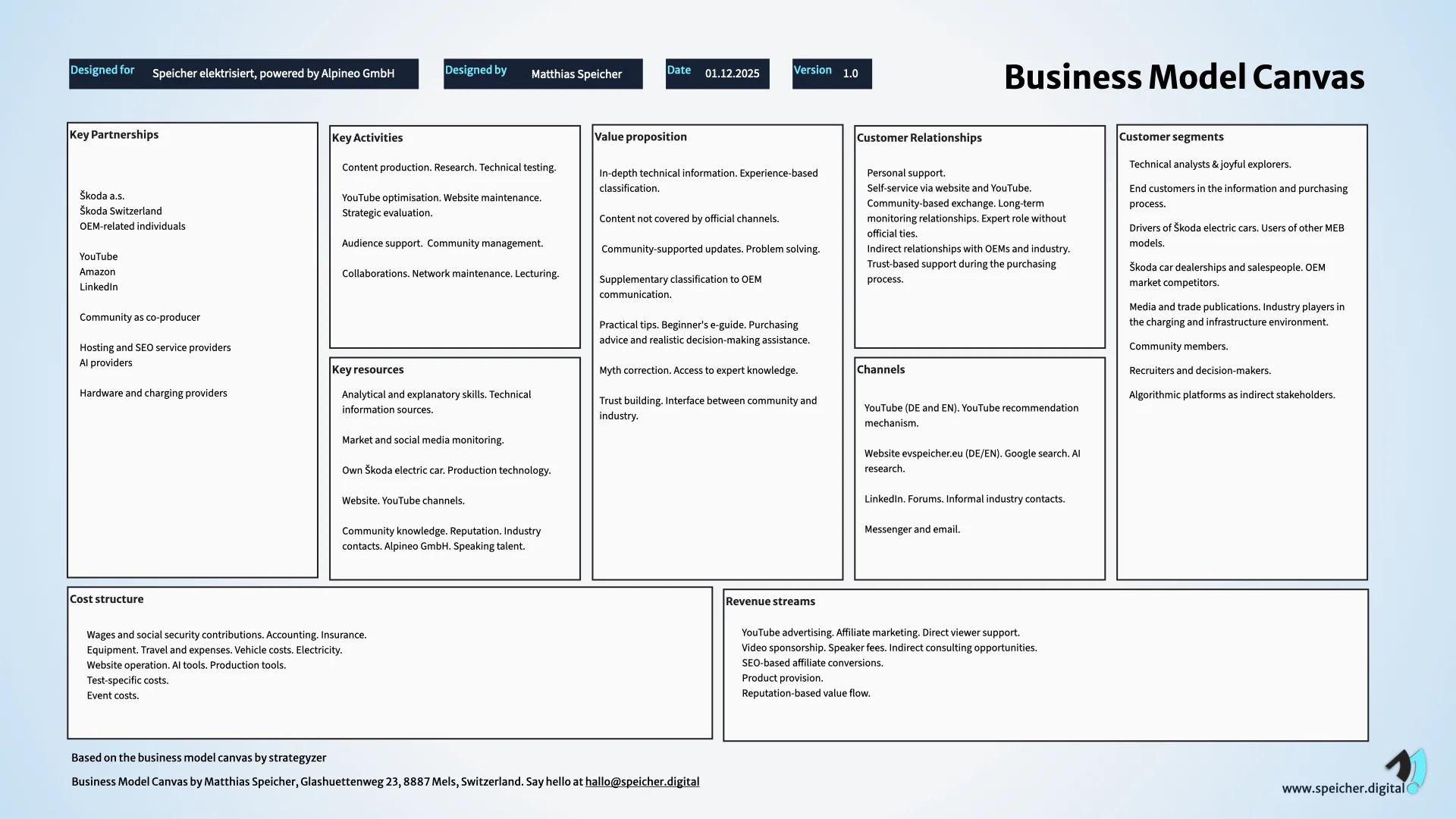
I use the Business Model Canvas as a structural tool to accurately map the model. It is an integral part of my work because I have been developing and managing digital products and markets using precisely these models for many years.
The central elements in Speicher elektrisiert’s BMC:
Value proposition
Technical clarity, comprehensible analysis, problem solving, reliable guidance.
Customer segments
Škoda and MEB drivers, buyers in the decision-making process, dealers, product managers, media.
Channels
YouTube (DE/EN), evspeicher.eu, LinkedIn, forums, Google search, direct communication.
Key resources
Analytical expertise, technical experience, community data, vehicles, production technology, website.
Key activities
Testing, measurements, scripting, content production, community management, website maintenance.
Revenue
YouTube ads, affiliate, sponsorship, speakers, individual consulting requests.
Costs
Equipment, vehicles, software, operations, travel, wages.
The canvas shows the project as a functional information system, not as a classic content operation.
The Lean Canvas: Focus on problem, segment, value and solution
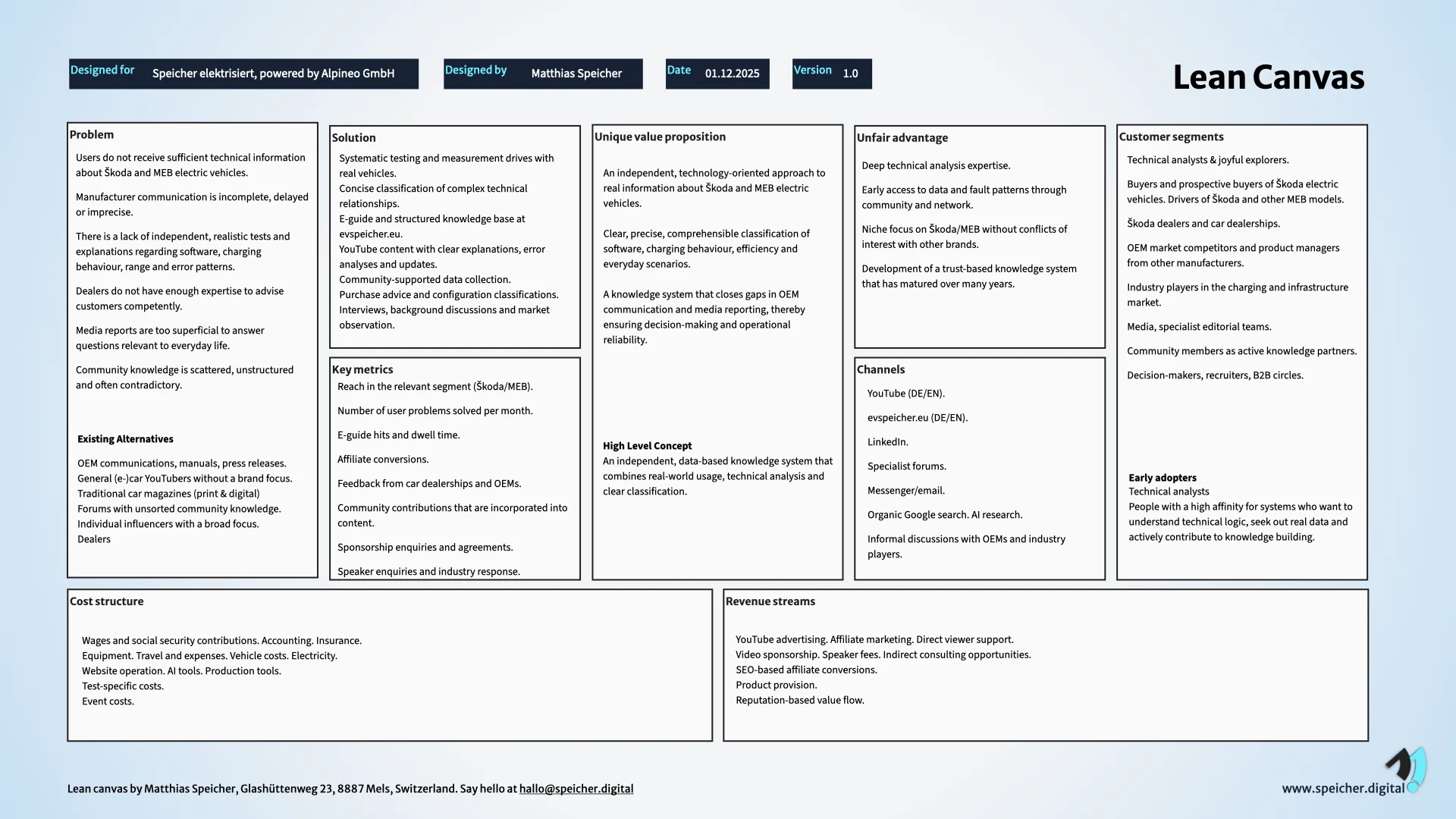
The Lean Canvas is the second tool I use. It serves to precisely describe the problem structure and value chain.
I have been using this model for many years in product and innovation projects. It is integrated into Speicher elektrisiert with corresponding consistency.
Problem
Users do not receive sufficient technical guidance.
Retailers cannot answer all questions.
OEM communication does not cover some everyday topics.
Real user data is only available in a scattered manner.
There is no independent authority that brings together technology, market behaviour and everyday life.
Early adopters
The first and most active users are technical analysts.
They seek precise data, understand system logic, provide error patterns and validate content.
They are clearly different from joyful explorers, who use the technology but do not analyse it.
Value proposition
Independent, technical, data-based guidance for vehicles on the MEB platform.
High Level Concept
A knowledge system that combines real-world usage, technical analysis and clear classification.
Solution
Test drives, tests, error analyses, e-guide, structured content, community integration.
The Lean Canvas shows the functional dynamics: Problem → User → Value → Solution.
Impact on the market and functional role
Both canvas models reveal the role that Speicher elektrisiert plays today:
- It structures real-world experience.
- It provides orientation in complex systems.
- It improves the knowledge base of users.
- It supports dealers who have reached their limits.
- It provides technical classification for OEM-related players.
- It forms a collective memory of the MEB platform.
The models clearly show that electrified storage is not a one-person channel, but a systemic information hub between the market, product and use.
Summary
Speicher elektrisiert is based on the tools I have been using in product development for many years: structural models, data-based analysis, clear derivation.
Business Model Canvas and Lean Canvas show the project as a functional, market-oriented knowledge system.
It combines technical depth, market logic, user reality and structured knowledge – thus creating the basis for independent, reliable orientation in the EV segment.